


Growing Up Without Knowing the Music in My Blood
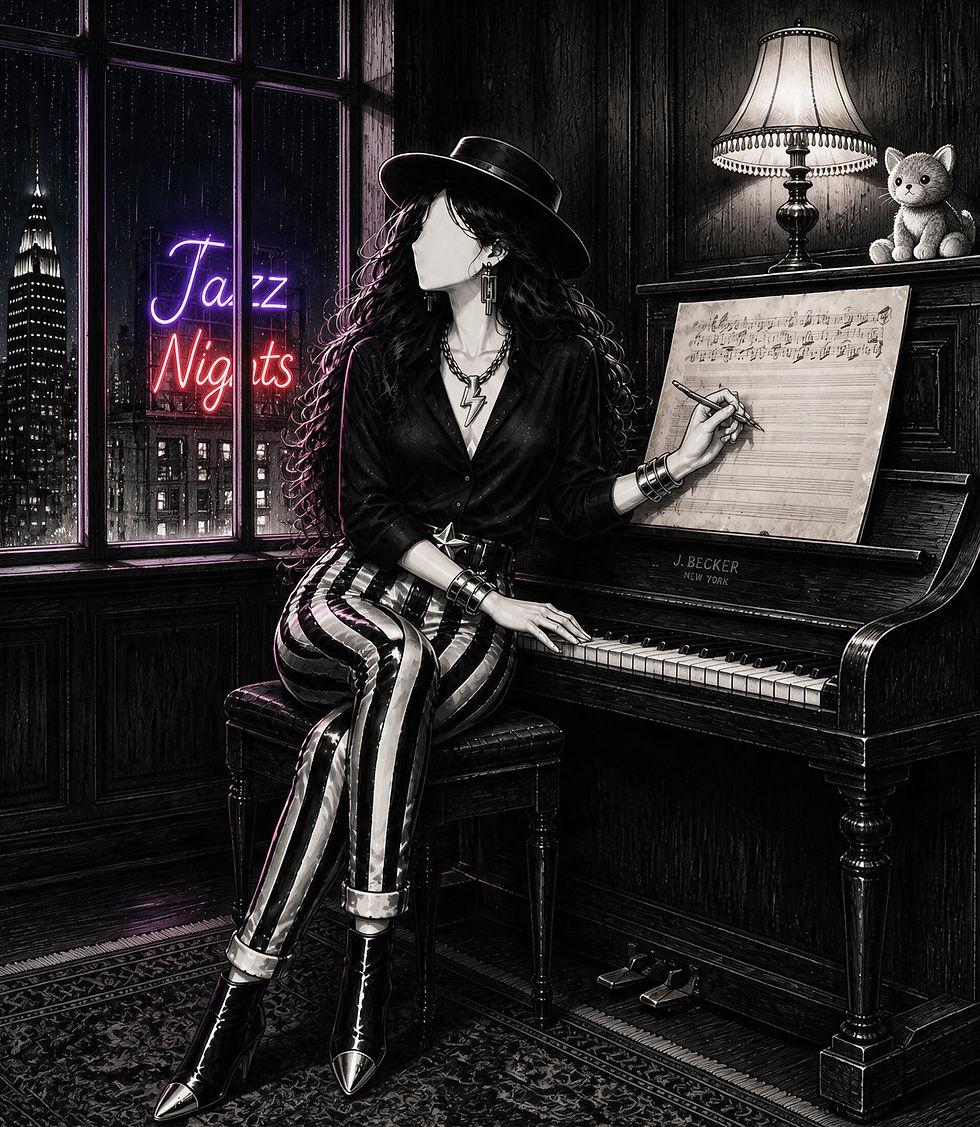
Nobody teaches a toddler to conduct an orchestra she can't yet name. Somebody just watches her do it and wonders where on earth it came from.
Before I could talk in full sentences, I was already keeping time — a foot tapping under whatever table I was sitting at, fingers drumming against my leg without my permission, small hands conducting invisible orchestras through the living room like I already understood there was more to music than just listening to it. It was never only about rhythm. Even then, music was already the gateway to whatever the rest of me turned out to be.
I wasn't raised in a house where music was a stranger — you already know that part. It was the wallpaper, the weather, always playing whether or not anyone in the family was even listening.
And still — still — there was a hunger in me that none of it fully explained. I needed music the way some people need silence or salt or the ocean. For a long time, I filed that need under the same label everyone in that small town filed the rest of me under: the wild one. It wasn't a badge back then. It was a verdict — from people who watched an energetic, restless kid want more than the quiet, ordinary life they'd already made peace with, and decided that meant something was wrong with her. I spent a good half of my life quietly agreeing with them, believing I was some kind of screw-up, before I ever heard a single story about my father and understood it wasn't a flaw at all. It was hereditary. I'm still the wild one today — just finally in the sense I should have been allowed to be from the start. Adventurous. Free. Nothing in that word ever needed fixing.
I started piano at five, small hands barely spanning an octave, already impatient with the pretty melody under my right hand and hungry for the left — that deeper, weightier sound underneath it. I remember the specific frustration of wanting both hands together, full and complete, faster than my fingers or anyone's lesson plan thought I was ready for. Nobody in that living room had a name for what I was chasing. I certainly didn't.
You already know about the afternoon on the sofa — I was ten, maybe eleven — the papers, the two lines that described a stranger with rhythm in his hands and a stranger with paintbrushes in hers. What I haven't told you is what happened to my music lessons after that day. Nothing changed on the outside. I kept showing up to the same school band room, same music lessons. But everything I played after that afternoon had a second, private layer underneath it that I didn't tell a soul about — a question I carried into every practice room for years: is this him? Is this the part of me that's him?
By sixth grade I'd already learned theory and music history — but that part was simply what music class was, nothing I went chasing on my own. What I did chase, without anyone assigning it, were the composers. Beethoven, Bach, Tchaikovsky, Chopin — I was just as fascinated by them the way other kids were fascinated by movie stars. I understood the language they wrote in, and I loved writing in it myself. From a very young age I'd sit at the piano with manuscript paper, carefully playing out notes and writing them down, certain that someday I'd have written a masterpiece of my own, just like the masters.
It was Henri Mancini who really stuck with me, though. It was 1975, and my cousin and I had gone to a cinema and seen the movie The Return of the Pink Panther. From that day on I was hooked on Mancini — that jazzy, mysterious sound hit me in the core of my soul.
Moon River, a piece that only took him thirty minutes to compose, was his most popular, and I really appreciate it, but Pink Panther stole my heart, as did his brilliance for creating instrumental themes for television and film. I loved movies and I loved TV as a kid, and I loved Mancini for that. And when Mancini worked his magic, I drowned myself in his creations.
He wrote melodies that didn't just stand in the background; they reached out and connected directly with your soul, forever linking his colorful musical landscapes to the emotions on the screen. Listening to Mancini's music feels like stepping into a warm, mid-century evening where the air is thick with anticipation and style. His instrumental palette was incredibly vibrant, a musical painting with colors that were completely new to Hollywood at the time. Instead of relying solely on heavy, classical symphonies, Mancini infused his scores with intimate, cool jazz, the playful brightness of pop, and a deeply felt emotional warmth. He used unexpected, intimate instruments to create a mood that felt incredibly sleek, sophisticated, and slightly mysterious — think of a late-night, smoky jazz club. He brought in muted trumpets, walking acoustic basslines, and low, purring saxophones into a piece I loved, The Pink Panther, like a cool velvet of sophistication. He mastered the art of cool.
At the heart of Mancini's music was a profound empathy for the human experience. He had a rare gift for capturing the bittersweet beauty of longing, love, and quiet moments, as with Moon River — gentle acoustic strumming, soaring strings that feel like a warm hug, and the intimate breath of a solo harmonica or flute. A warm, compassionate glow of nostalgia.
And when he wrote for TV thrillers and detective shows, his music didn't just sound like danger — it sounded incredibly cool. He traded classical tension for a modern, driving pulse: sharp, slashing brass chords, heavy electric guitar riffs, and driving percussion that felt like a racing heartbeat. In another favorite of mine, one I still love playing on my drums, the Peter Gunn theme, the music hits you with a dark, neon-lit energy. The relentless bassline propels you straight down a rainy, asphalt city street in the dead of night. It's sharp, urgent, electrified.
The inspiration of Mancini's eclectic sounds carried a vision of that glamorous mid-century era that, for me, made childhood taste like tangerine orange, turquoise, and mustard yellow. Growing up in the late '60s and early '70s, I felt like I was living inside a moving piece of modern art — a vibrant, space-age world that left me completely spellbound.
I can still hear the rhythmic click of white vinyl go-go boots snapping against a sidewalk. Those impossibly sharp A-line shift dresses covered in bold, geometric color-blocking. To my child-sized eyes, women looked like glamorous superheroes who had just stepped off a rocket ship. Everything about the fashion felt forward-looking, crisp, and fiercely optimistic. The real magic happened when the sun went down, when parents hosted parties and living rooms transformed into sophisticated sanctuaries of adult glamour. Crystal martini glasses clinked together like musical chimes. Elegant plumes of smoke curled lazily from long, pearl-handled cigarette holders. Low, cinematic laughter mixed with jazz vinyl spinning on the hi-fi console.
It was a world of absolute mystery and sophistication — a private club where the adults held all the secrets, and I couldn't wait to grow up and get inside. It still holds a lot of my fashion inspiration and home decor today. That era cast a spell on me that lives in me still, and it's part of who I am.
By the time I graduated, I could play five distinct instruments outright, and if you broke the percussion line down piece by piece — xylophone, timpani, marimba, and so on — that number climbed considerably higher. I was, by any outside measure, thoroughly trained. What I still don't know, and may never know, is how much of it was inherited and how much simply came from growing up in a house that handed me a piano, a mother who'd studied music herself, and an era when the radio and the record player were never really off. Nature or nurture — I've never been able to cleanly pull the two apart.
All of it felt, at the time, like a handful of separate loves with no throughline between them — the composers, the manuscript paper, Mancini's cool jazz-noir, the drum kit. It would be years before I even started to wonder if they were pointing at the same thing, or if I only wanted them to. How did I arrive here? Nature, nurture, or some tangle of both I doubt I'll ever fully unravel.
I met my father for the first time as a grown woman, and found out — the way you find out something you'd already half-known your whole life — that music hadn't only given him rhythm, either. He never let go of his own dream of being a musician, not even after the rest of his band eventually did, and I've always assumed that meant he heard it the way I do — not just how a song hits you, but how it's built underneath. I'll never know for certain. He didn't live long enough for me to ask him. But I do know this: while I was a child on the edge of some living room, spellbound by martini glasses and cigarette smoke and jazz on the hi-fi, wondering what secret world the adults all belonged to — he was already living inside a version of it. Somewhere else entirely, at the very same time.
This isn't a story about music lessons paying off. It's a story about finding out, at midlife, that a hunger I'd spent years mislabeling — screw-up, too much, the wild one — was never something broken in me that needed explaining. It was never only the rhythm, either, or the composers, or the go-go boots and martini-glass glamour I couldn't stop staring at as a kid. It was all of it, tangled together, and I still can't tell you with any certainty how much of it came from blood and how much simply came from being alive in a particular decade, in a particular house, with the radio always on. I've finally stopped needing to solve that math. I didn't spend my life becoming the wild one, the hungry one, the one who wanted the whole spellbound world for herself. I'd already been her — long before I had a name, or a father, or an era, to explain why.
— Domino


Comments